A mysterious radio signal has reached Earth after traveling through space for more than 11 billion years. The signal is a fast radio burst, or FRB. These powerful flashes of radio energy usually last only a few milliseconds, and scientists still do not fully understand what produces them.
The burst, named FRB 20240304B, was detected by the MeerKAT radio telescope in South Africa on March 4, 2024. Later, the James Webb Space Telescope found its home galaxy. The signal began its journey when the universe was only about three billion years old. It is the most distant FRB whose home galaxy has been identified. (science.nasa.gov)
The galaxy itself surprised the research team. They had expected a large galaxy with many stars. Instead, they found a small dwarf galaxy that was actively creating new stars. It was about 1,000 times less massive than expected, and many of its stars may have formed within only 30 million years. (science.nasa.gov)
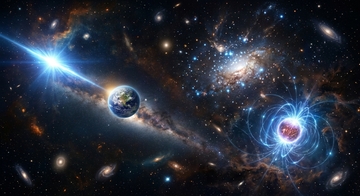
This discovery may offer an important clue about the source of FRBs. One idea is that two neutron stars produce an FRB when they crash into each other. However, such a crash can take billions of years to happen. Because this burst came from a young galaxy, scientists think it was more likely produced by a magnetar—a young neutron star with an extremely strong magnetic field. A sudden “starquake” on its surface may have created the burst. (api.uva.nl)
FRBs are also useful tools. As their radio waves travel across the universe, they pass through gas, galaxies, and other structures. The waves carry information about everything along their path. Therefore, these short signals can act like cosmic flashlights, helping scientists study matter that is normally difficult to see.