Have you ever looked up at night and thought, “Wait, why is the sky green?” This week, that strange idea became more real for many people. On Wednesday, June 3, 2026, NOAA said a strong geomagnetic storm, a G3 storm, was expected for June 4 to 5 UTC. NOAA said three bursts from the Sun, called coronal mass ejections, were expected to reach Earth and interact with our planet. (swpc.noaa.gov)
And here is the surprising part. During a G3 storm, the aurora can spread much farther south than usual. On NOAA’s scale, aurora during G3 storms has been seen as low as Illinois and Oregon. (swpc.noaa.gov)
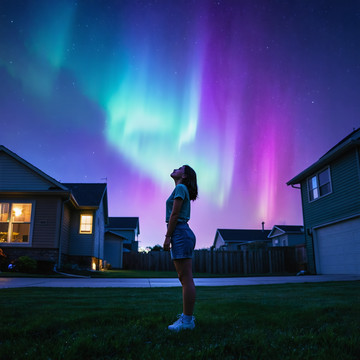
So imagine this. Emi finishes dinner, takes out the trash, and sees her neighbor looking north. “Come outside,” he says. “The sky looks different.” Usually, Emi would never expect the northern lights near home. But on a dark night, away from bright city lights, people can sometimes catch the aurora. NOAA says it is often best around 10 p.m. to 2 a.m. local time, and you need real darkness to see it well. (swpc.noaa.gov)
But what is the aurora, really? NASA says it happens when energetic particles from space hit atoms and molecules in Earth’s atmosphere. That gives the sky its glow. Green light often comes from oxygen. Other colors, like red, blue, pink, and purple, can appear too. (science.nasa.gov)
So yes, a solar storm can sound big and distant. But sometimes it becomes a quiet moment in your own neighborhood. You step outside, look up, and the sky tells you the Sun has reached all the way to Earth. And for one night, science is not far away at all.