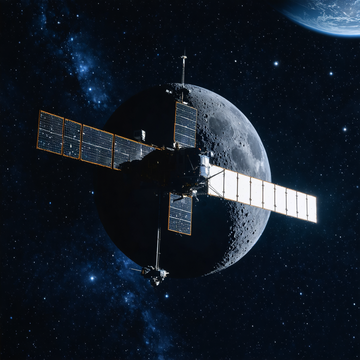
Have you ever looked at the Moon on an ordinary night and felt it was somehow both near and impossibly far? For more than half a century, that was the human situation too. We could see the Moon, study it, dream about it, but no crew had gone back. Then, on April 1, 2026, Artemis II lifted off from Kennedy Space Center at 6:35 p.m. EDT, sending Reid Wiseman, Victor Glover, Christina Koch, and Jeremy Hansen toward the Moon inside NASA’s Orion spacecraft. It was the first crewed lunar mission since the Apollo era. (nasa.gov)
Now, here is the interesting part. Artemis II was not a landing mission. It was a test flight, but not a small one. The crew checked Orion’s life-support, navigation, power, and thermal systems in deep space. Soon after launch, they also manually flew Orion during a close-range maneuver to see how the spacecraft handled with humans aboard. Think of it like taking a brand-new car onto a long night drive before trusting it for the biggest trip of your life. Artemis II was doing that for the road to the Moon. (nasa.gov)
Then the mission became something more than a test. On April 6, during a seven-hour lunar flyby, Orion passed about 4,067 miles above the Moon’s surface. That same day, the crew broke the human distance record once set by Apollo 13, eventually reaching about 252,756 miles from Earth. Jeremy Hansen also became the first Canadian, and the first non-American, to take part in a lunar mission. Four days later, on April 10, Orion splashed down in the Pacific off the coast of California, ending a journey of nearly 10 days. (nasa.gov)
So the real story of Artemis II is this: a new age of exploration did not begin with a flag or a footprint. It began with a careful trip around the Moon, proving that humans can go far, come home safely, and get ready to go farther next time. (nasa.gov)