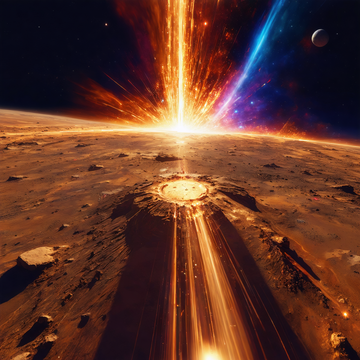
Have you ever wondered about Mars? Long ago, Mars was not just a cold, dry world. NASA says water once flowed on its surface. That also means Mars had a much thicker atmosphere in the past. But today, the air on Mars is very thin, only about 1% as thick as Earth’s. (science.nasa.gov)
So where did that air go? A big part of the answer is the Sun. Mars lost its main magnetic field early in its history. After that, the solar wind could hit the planet’s upper air more directly. The solar wind is a stream of charged particles from the Sun, and over a very long time, it helped strip Mars’s atmosphere away into space. (science.nasa.gov)
Then came an important new result. On May 29, 2025, NASA announced that its MAVEN spacecraft had made the first direct observation of a process called sputtering. Sputtering happens when fast, energetic particles crash into the upper atmosphere and knock atoms out into space. Scientists had clues before, but this was the first time they saw it directly. (science.nasa.gov)
MAVEN used three instruments and many years of data to make a new map of argon high above Mars. That map showed argon in the same places where energetic particles were hitting the atmosphere. NASA also said this escape process was happening about four times faster than earlier predictions, and it became stronger during solar storms. (science.nasa.gov)
So, where did Mars’s air go? Bit by bit, much of it escaped into space. And when the air became thin, liquid water could no longer stay easily on the surface. That is why this new NASA discovery matters so much. It helps explain how Mars changed from a wetter world into the dry red planet we see today. (science.nasa.gov)