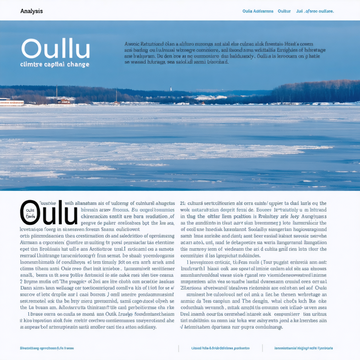
In 2026, Oulu is not trying to imitate Copenhagen or Stockholm. As one of Europe’s two Capitals of Culture this year, it has built its programme around the idea of “Cultural Climate Change,” unfolding through 646 cultural projects and roughly 3,500 events across 40 northern municipalities. One of its central strands, “Brave Hinterland,” deliberately spotlights Arctic conditions, small communities, and places usually dismissed as Europe’s margins. The gamble is both cultural and political: can a city at the edge persuade visitors that the edge is where the most original stories now begin? (culture.ec.europa.eu)
The most compelling answer may be Ovllá, which had its world premiere on January 16, 2026. Oulu2026 calls it the first full-length opera ever premiered in Finland in the Northern Sámi language. Created with Oulu Sinfonia and the Sámi National Theatre Beaivváš, the work confronts the legacy of assimilation: children separated from family, language transformed into shame, memory turned into silence. Musically, it brings Western opera into contact with joik, producing not a token fusion but a serious artistic argument about who gets to occupy the grand stage. (oulu2026.eu)
Yet Oulu2026 is not only cerebral; it is sensuous, even bodily. The programme has invited audiences to dance on the frozen sea at the Frozen People festival, while the Winter Swimming World Championships in early March were paired with “a unique sauna world” and what organisers described as the world’s largest ice sauna. Visit Oulu also promotes sauna tents set directly on the frozen sea near Nallikari, where bathers can move from wood heat to an ice hole within minutes. In Oulu, climate is not a background condition. It is the medium of culture itself. (oulu2026.eu)
Can Oulu really make the periphery the protagonist? No festival can abolish inequality, and Indigenous culture always risks being consumed as picturesque novelty. Still, the early signs are striking: the January opening festival drew more than 250,000 visits across around 200 events, making it, by Oulu2026’s own estimate, one of the largest events in the city’s history. If that momentum endures, Oulu may prove that Europe’s next cultural frontier lies not in its old centers, but in colder, quieter places that refuse to remain secondary. (oulu2026.eu)