What changes a city more: a tall building, or the way your walk to the bus suddenly feels different? In Chicago’s Jackson Park, the answer may be both. On a normal morning, you might come down Stony Island Avenue, look past the trees, and see the Obama Presidential Center rising above them like a dark stone marker. The museum tower is about 225 feet tall, and the full campus covers 19.3 acres in the historic park. It officially opens on June 19, 2026, on Juneteenth. (apnews.com)
But the bigger change may happen closer to the ground. The center is not only a museum. The campus includes a Chicago Public Library branch, gardens, walking trails, a playground, public art, and a Sky Room with views of the South Side and Lake Michigan. Around it, Chicago has rebuilt nearby streets and green space. A half-mile stretch of Cornell Drive was removed, turning what had been a six-lane road through the park into more walkable landscape linked to the lagoon. Stony Island Avenue was also widened and given a tree-lined median. (obama.org)
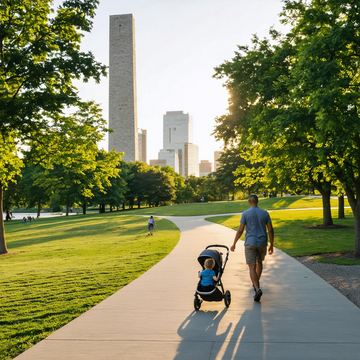
So picture one small scene. A parent pushes a stroller. A child runs toward the playground. Someone stops at the library, then keeps walking toward the water. That is one way a city changes: not only by adding a new landmark, but by changing the rhythm of an ordinary afternoon. (obama.org)
Of course, not everyone is happy. Some residents and critics say the tower feels out of place in a park shaped by history, and some neighbors still fear displacement as the area grows more valuable. So the Obama Presidential Center may change Chicago in two ways at once: by reshaping the skyline, and by reopening an old question about who gets to shape the city below it. (architecture.org)