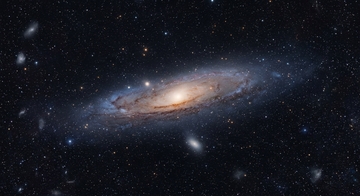
Astronomers have found 47 possible “ghost galaxies” hiding in deep space. The discovery was reported in September 2026. These objects are called ghost galaxies because their light is extremely weak, not because they are truly ghosts. They are dwarf galaxies, which are much smaller and less massive than large galaxies such as our Milky Way. (arxiv.org)
The team studied an area around three larger galaxies: NGC 5068, NGC 5084, and NGC 5087. They are about 17 million, 80 million, and 100 million light-years from Earth. The scientists used the VLT Survey Telescope in Chile to take the deepest optical images ever made of this area. Only four of the 47 objects had been reported before. (media.inaf.it)
Interestingly, computer programs did not make the discovery. Three researchers carefully examined the images themselves. They also had to hide the bright light from nearby stars in the images. Otherwise, the weak light of the dwarf galaxies would have been difficult to measure.
The objects have colors and shapes similar to known dwarf galaxies. Some look round and smooth, while others may have spiral or irregular structures. Scientists estimate that each one has a mass between one million and one billion suns. However, they are still called “candidates.” Future observations must measure their distances and speeds before astronomers can confirm what they are. (media.inaf.it)
This discovery may help solve an important space mystery. Computer models have predicted many small satellite galaxies around larger galaxies, but astronomers have sometimes found fewer than expected. By studying these nearly invisible islands of stars, researchers may learn more about how galaxies form and how dark matter shapes the universe. Ghost galaxies are faint, but they could provide valuable clues about some of the biggest questions in astronomy.