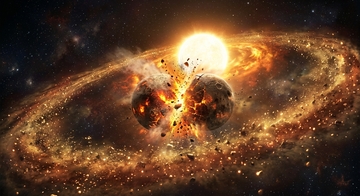
The James Webb Space Telescope has found strong signs of huge collisions in young planetary systems. However, Webb did not take a direct picture of two planets hitting each other. Instead, it studied warm clouds of dust left behind after violent crashes. These clouds form rings called “extreme debris disks” around young stars. (science.nasa.gov)
In a study published on October 1, 2026, scientists examined 21 extreme debris disks. Such disks are rare and may appear around only about 1% of young stars. Webb studied the disks in mid-infrared light, which allowed researchers to learn about their heat and minerals. They found very small dust grains, large amounts of warm dust, and changes in brightness. These features suggest that fresh material is moving and crashing around the stars. (science.nasa.gov)
The researchers divided the disks into two groups. About one-third were rich in silica, a material found in rocks and glass. Scientists believe these disks were created by powerful collisions between objects about the size of Mars. The crashes were so energetic that much of the rock turned into vapor. The other disks had less silica. They probably came from slower collisions in which Moon-sized objects touched or passed very close to each other. (science.nasa.gov)
These findings may help us understand our own planet’s history. Scientists think that, early in the solar system’s life, a Mars-sized object called Theia hit the young Earth. Material from that collision later came together and formed the Moon. By studying distant debris disks, Webb is giving us a window into similar events. Planetary collisions may look destructive, but they can also create new worlds and moons. (science.nasa.gov)