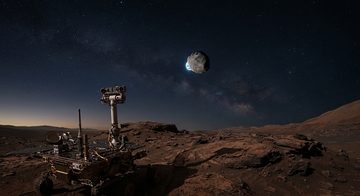
In April 2026, NASA announced that the Curiosity rover had found the most diverse group of organic molecules ever detected on Mars. In one rock sample, scientists identified 21 carbon-containing molecules, and 7 of them had never been seen on Mars before. Organic molecules are important because they are the chemical building blocks of life, but they can also be made by non-living processes. So this discovery is exciting, but it is not proof of life. (jpl.nasa.gov)
The sample came from a drill site called “Mary Anning 3,” collected by Curiosity in 2020 on Mount Sharp in Gale Crater. Long ago, this area had lakes and streams. Over time, clay minerals formed there, and clay is very good at protecting organic material. Scientists used Curiosity’s SAM mini-lab to study the powdered rock. For this experiment, SAM used a special wet-chemistry method with a strong liquid called TMAH for the first time on another world. (jpl.nasa.gov)
Among the new finds was a nitrogen heterocycle, a ring-shaped molecule that contains nitrogen. NASA says this kind of structure is considered a predecessor to RNA and DNA, which carry genetic information in life on Earth. Scientists also found benzothiophene, a molecule that contains carbon and sulfur and is also known from some meteorites. The Nature Communications paper says the experiment released more than 20 organic molecules from a clay-bearing Martian rock, showing that complex organic matter can survive for about 3.5 billion years in Mars rock. (jpl.nasa.gov)
This discovery also connects to earlier news. In March 2025, Curiosity found decane, undecane, and dodecane, the largest organic molecules known on Mars at that time. Scientists think they may be pieces of fatty acids. Then, in February 2026, a NASA study said the non-living sources they tested could not fully explain the amount of organic material in one Martian sample, although more research is still needed. In short, Mars is not yet proven to have had life, but it is becoming a more interesting place to ask that question. (science.nasa.gov)