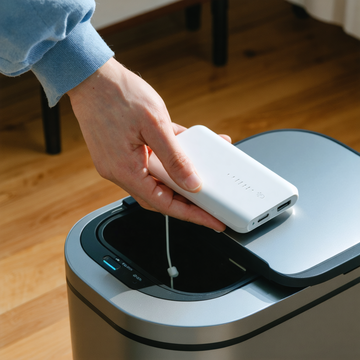
Have you ever stood by the trash can with an old power bank in your hand and thought, “It’s tiny, so it should be fine”? That small moment is the new battery-age mistake. In Japan, lithium-ion batteries are now in earbuds, shavers, toys, fans, and phone chargers. But when those batteries are crushed inside a garbage truck or a waste machine, they can catch fire. In Japan’s municipal waste system, there were 9,923 fire incidents linked to lithium-ion batteries in fiscal 2024, and if you also count smoke and small flare-ups, the number was 23,068. (lithium.env.go.jp)
Now picture Mika, cleaning her room on a rainy Sunday. She finds an old mobile battery, one wireless earbud, and a small hand fan that no longer works. At first, she plans to throw them out with burnable trash. Then she remembers hearing that battery rules are changing. She checks her city website. Good thing she did. In March 2025, Japan revised its standard household waste guideline and added lithium-ion batteries and products using them as a separate sorting category. Still, the rule is not exactly the same everywhere, so the Environment Ministry says households should follow their own city or ward’s rules. (env.go.jp)
Here is the important turn. “Recycle” does not mean “any bin is okay.” In fiscal 2024, 1,313 municipalities in Japan, or 77.3%, said they collected lithium-ion batteries or products that use them, and that number was rising. Collection methods also differ: some cities ask for drop-off at a clean center or city office, and some guide people to partner stores or JBRC collection points. JBRC also says a phone-charging mobile battery should be handed in as a whole unit, not taken apart, and damaged or swollen batteries need different handling. (lithium.env.go.jp)
So the new common sense is simple. If it has a battery, stop for one more minute. That one minute may save a truck, a factory, or someone’s ordinary day.