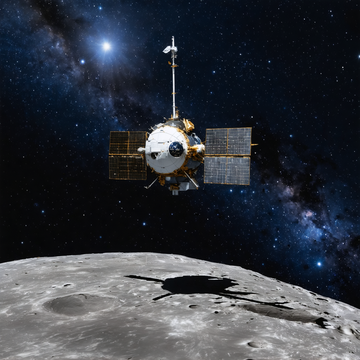
More than 50 years after Apollo 17 in 1972, people finally flew around the Moon again. NASA’s Artemis II mission launched on April 1, 2026, from Kennedy Space Center in Florida. The crew was Reid Wiseman, Victor Glover, Christina Koch, and Canadian astronaut Jeremy Hansen. They rode NASA’s giant SLS rocket and traveled in the Orion spacecraft, which the crew named Integrity. Artemis II was the first Artemis mission with astronauts on board, and one of its main goals was to test Orion and its life-support systems in deep space. (nasa.gov)
The mission lasted nearly 10 days. Orion flew around the Moon, passed the far side, and came as close as about 4,067 miles above the lunar surface. At its farthest point from Earth, the crew reached 252,756 miles, setting a new record for the greatest distance humans have ever traveled from our planet. On April 10, 2026, the astronauts returned safely and splashed down in the Pacific Ocean off the coast of California. In total, they flew 695,081 miles. (nasa.gov)
Artemis II was not only a trip around the Moon. It was also an important test mission for the future. During the flight, the crew checked spacecraft systems, practiced piloting, and helped with science. They photographed the Moon’s surface and supported studies about human health in deep space. One experiment, called AVATAR, used tiny organ chips to study how radiation and microgravity affect the body. Jeremy Hansen also made history as the first Canadian to go on a mission around the Moon. For many people, Artemis II feels like the beginning of a new age of lunar exploration. (nasa.gov)