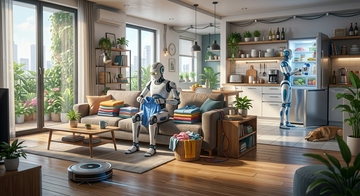
Imagine coming home and finding clean floors, folded clothes, and an empty dishwasher. As of September 2026, household robots are moving closer to this dream, but they are not perfect robot servants yet.
Robot vacuum cleaners are the most successful example. Newer models can make maps of rooms, recognize carpets, and avoid objects on the floor. Some cleaning stations can empty the robot’s dust, wash and dry its mop pads, and clean themselves. This means that owners do not need to give the robot a hand after every cleaning job. (media.irobot.com)
More flexible robots are also being developed. LG’s CLOiD has two arms, ten moving fingers, cameras, and a wheeled base. At CES 2026, it demonstrated tasks such as taking milk from a refrigerator, preparing an oven, and folding clothes. LG is now training CLOiD in a model home where it can repeat cleaning tasks and learn from experience. (lg.com)
Other companies are working on similar ideas. The human-shaped NEO robot from 1X is designed to organize shelves, carry objects, and fold laundry. However, when it faces a task that it does not know, a human expert may guide it from another location. NEO was offered for preorder at $20,000, with early deliveries planned for 2026. (1x.tech)
Sunday Robotics’ Memo can collect dishes, throw away food, load a dishwasher, and fold socks. Still, it is being prepared for a beta test in late 2026 rather than normal store sales. Its developers also say that it usually works at about half the speed of a person. (sunday.ai)
So, how intelligent are household robots? They have become efficient at clear, repeated jobs, especially floor cleaning. They can also learn more complex actions by studying human movements and large amounts of data. However, an untidy home is much more difficult than a factory. For now, robots can save time, but most people should not say goodbye to housework just yet.