For years, the global power story followed a familiar pattern: when electricity demand rose, fossil-fuel generation usually rose with it. In 2025, that pattern finally broke. According to Ember’s latest global power analysis, renewable generation increased by 887 terawatt hours, while total electricity demand grew by 849 terawatt hours. That meant renewables did not merely keep up with demand; they grew faster than demand itself. As a result, renewables supplied 33.8% of the world’s electricity in 2025, while coal’s share fell below one-third for the first time in modern history. (apnews.com)
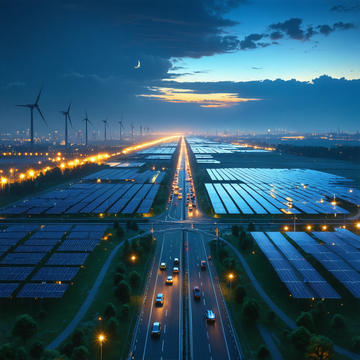
The biggest reason was solar power. Global solar generation jumped 30% in 2025, and solar alone covered three-quarters of the net increase in electricity demand. When wind is added, the two sources met 99% of demand growth. This is not an accident or a lucky weather effect. The IEA had already forecast that renewables would provide more than one-third of global electricity in 2025 and that wind and solar would cover over 90% of the year’s demand increase. In other words, 2025 was the moment when earlier forecasts became visible reality. (apnews.com)
China and India were central to this shift. China accounted for more than half of the world’s growth in both solar capacity and solar generation, and it also delivered most of the increase in wind output. India recorded its strongest-ever gains in solar and wind, helped by solid hydropower and slower demand growth than in previous years. Remarkably, both China and India saw declines in fossil-fuel generation in 2025—the first time this century that both countries moved in that direction together. (apnews.com)
A deeper force also lies behind the numbers: electricity demand is expanding because modern life is becoming more electric. The IEA says demand has been pushed up by air conditioning, electricity-intensive manufacturing, electric vehicles, heat pumps, digitalisation, data centres and AI. Yet renewables are no longer too small or too slow to respond. Their scale, speed and falling integration costs—especially with fast-growing battery storage—are starting to reshape the system. So the real significance of 2025 is not just one impressive statistic. It is the possibility that from now on, a more electrified world does not automatically mean a more fossil-fuelled one. (iea.org)