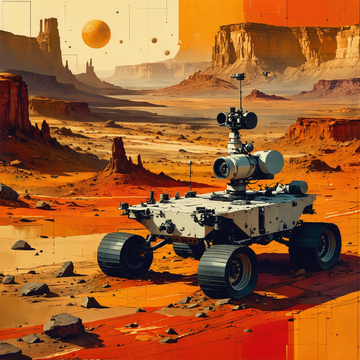
When people hear that NASA has found “new organic molecules” on Mars, it is tempting to imagine fossils, microbes, or final proof that the planet once hosted life. The latest discovery is exciting, but the truth is more delicate. On April 21, 2026, NASA announced that Curiosity had identified the most diverse set of organic molecules yet found on Mars in a rock sample called Mary Anning 3, drilled in Gale Crater in 2020. Scientists reported more than 20 carbon-bearing molecules, including seven never before detected on Mars. Among them were benzothiophene and a nitrogen heterocycle, a ring-shaped molecule especially interesting because similar structures can be chemical precursors to RNA and DNA. The sample came from clay-rich rocks formed in an ancient environment of lakes and streams, where organic matter can survive for immense spans of time. (jpl.nasa.gov)
Still, “organic” does not mean “biological.” Organic molecules are simply carbon-containing compounds, and they can be created by living organisms or by non-living chemistry. NASA has stressed that Curiosity cannot determine, from these detections alone, whether the molecules came from life or from geology. That same caution applied to Curiosity’s March 24, 2025 announcement of decane, undecane, and dodecane in the older Cumberland sample. Those compounds were interpreted as possible fragments of fatty acids. On Earth, fatty acids are important parts of living cells, but they can also form without life through geochemical processes such as reactions involving water and minerals. (jpl.nasa.gov)
So, are these molecules traces of life? Not yet—but they are becoming harder to ignore. A study published on February 4, 2026 argued that the amount of long-chain organics inferred for the Cumberland mudstone is difficult to explain using the non-biological sources the researchers examined, such as meteorites or haze from an ancient atmosphere. Even so, the authors did not claim to have found life. They said more work is needed, because an unusual abiotic process could still be responsible. In other words, Mars is offering stronger clues, not a final answer—and perhaps that uncertainty is what makes the mystery so compelling. (journals.sagepub.com)