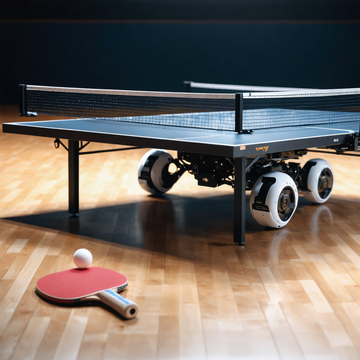
For years, AI looked strongest in digital worlds such as chess, Go, and video games. Physical sport was different. A robot had to see a fast-moving ball, read its spin, move with perfect timing, and respond to an unpredictable human body. That is why table tennis has become such an important test. In August 2024, Google DeepMind reported a robot that reached amateur human level: it won 45% of 29 matches overall, beat all beginner players, beat 55% of intermediate players, and still lost every match against the most advanced opponents. (deepmind.google)
Now the field has clearly moved forward. On April 23, 2026, Sony AI published a Nature paper on “Ace,” an autonomous table-tennis robot that played under official International Table Tennis Federation rules. In the results described in the paper, Ace defeated elite players in three of five matches and produced 16 direct points from its serves against them, although it still lost to the two professional players it faced at that stage. Sony calls this the first known real-world autonomous system competitive with elite and professional-level human table tennis players. (ai.sony)
What makes Ace special is not only power, but perception. Sony says the robot uses 12 high-speed sensors, including event-based cameras, to track the ball and its spin with a perception latency of 10.2 milliseconds. Its control policy, trained with reinforcement learning, runs at 1 kHz, and the hardware can return balls at up to 19.6 meters per second. In testing, Ace achieved a return rate above 75% against heavy spin and could even react to rare net-bounce shots. (ai.sony)
The most exciting point is that the paper may already be slightly behind the robot. Sony reports that after the Nature submission, Ace improved further: in December 2025 it beat both elite players and one professional player in new matches, and in March 2026 it defeated three new professional players at least once. So, can a table-tennis robot beat top human players? Not consistently yet, and certainly not the world’s very best. But the latest research shows that “embodied AI” has entered a new stage: machines are no longer only thinking fast, but competing with skilled athletes in the messy, physical real world. (ai.sony)