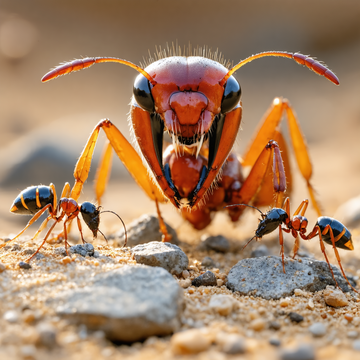
In April 2026, scientists reported a very unusual ant behavior from the desert of southeastern Arizona. A researcher named Mark W. Moffett described what seems to be the first known case of one ant species “cleaning” another ant species. The smaller ants are cone ants from the genus Dorymyrmex, and the bigger ants are red harvester ants, Pogonomyrmex barbatus. The study was published in Ecology and Evolution on April 12, 2026. (pubmed.ncbi.nlm.nih.gov)
The scene is surprising. A large harvester ant walks to the entrance of a cone ant nest and stands very still. It often raises its body and opens its jaws wide. Then one or more tiny cone ants climb onto the larger ant and lick or nibble its body. Sometimes they even go between the big ant’s open jaws. Instead of fighting back, the harvester ant stays calm and allows the treatment. Moffett observed at least 90 harvester ants doing this, and the cleaning sessions lasted from less than 15 seconds to more than 5 minutes. In some cases, as many as five cone ants worked on one large ant. (sciencedaily.com)
Why do they do this? Scientists do not know for sure yet. The small ants may be eating tiny bits of food or oils from the harvester ants’ bodies. The larger ants may get help removing dirt, spores, parasites, or other harmful material from places that are hard to clean by themselves. Moffett also tested dead harvester ants near the cone ant nests. The cone ants showed some interest, but they did not do the same licking and nipping behavior, which suggests that signals from a living ant are important. (sciencedaily.com)
This discovery is exciting because ants are usually famous for war, stealing, and competition. But these Arizona ants may show a gentler side of insect life. In a way, they are like “cleaner fish” in the ocean, proving that even in the tiny world of ants, nature can still surprise us. (pubmed.ncbi.nlm.nih.gov)