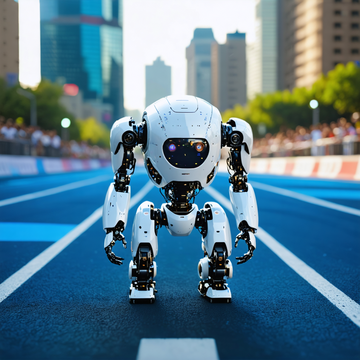
On April 19, 2026, Beijing E-Town held its second humanoid robot half-marathon, and the progress in just one year was striking. The winning robot, Shandian (“Lightning”) from Team Monkey King, finished the 21.0975-kilometer course in 50 minutes 26 seconds. In the first race, held on April 19, 2025, Tiangong Ultra needed 2 hours 40 minutes 42 seconds to win. Before the 2026 event, organizers said applications had come from more than 100 teams, covering 26 robot brands and over 300 humanoid robots—almost five times the number of teams in the first year. (english.beijing.gov.cn)
The race was exciting because it was not just a show. Robots ran on the same route as humans, but barriers or green belts separated them for safety. The course included flat roads, slopes, curves, narrow sections, and more than ten kinds of terrain, so it tested balance, endurance, navigation, and control in real outdoor conditions. The 2026 rules also pushed teams toward greater independence: robots competed in autonomous-navigation and remote-control categories, and the scoring system favored more autonomous machines. Even so, the event still showed how difficult the challenge is. In 2025, robots had human navigators, operators, engineers, and battery-swap pit stops, and in the 2026 race one robot fell at the start while another hit a barrier. (english.beijing.gov.cn)
This rapid improvement helps explain why the Beijing race has drawn so much attention. After the 2025 event, Tiangong Ultra’s team said they had improved body stability, lightweight design, heat dissipation, motion-control algorithms, gait stability, and complex-terrain ability. By 2026, a robot in Beijing had posted a winning time faster than the current human half-marathon world record, at least under the event’s own rules. Beijing officials describe the race as a chance for technology validation and industrial showcasing, while AP reports that China’s 2026–2030 plan includes faster development of humanoid robots and their real-world applications. In that sense, this half-marathon is more than a race: it is a public test of how close humanoid robots are coming to everyday life. (english.beijing.gov.cn)