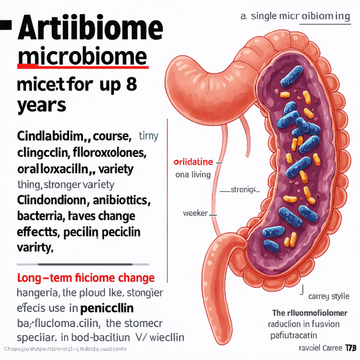
In March 2026, a large study gave a surprising answer. It suggests that one course of antibiotics can change the gut microbiome for years. The gut microbiome is the big group of tiny living things in your intestines. The study did not test one pill. It looked at one full course of oral antibiotics. Researchers used prescription records and stool samples from 14,979 adults in Sweden. They found the biggest drop in bacterial variety in the first year after antibiotics, but links were still seen 1 to 4 years later and even 4 to 8 years later. (pubmed.ncbi.nlm.nih.gov)
Not all antibiotics had the same effect. The strongest long-term links were seen with clindamycin, fluoroquinolones, and flucloxacillin. For these drugs, use 4 to 8 years earlier was linked to changes in about 10% to 15% of the bacterial species the scientists studied. Penicillin V, a common antibiotic in Sweden, was linked to much smaller and shorter changes. (nature.com)
The story gets even more interesting. When the team compared people who had taken only one antibiotic course with people who had taken none in the previous 8 years, they still found lower bacterial variety for several antibiotic types. Their model also suggested that recovery is fastest in the first 2 years, then becomes slower. So the gut may heal, but some changes may stay for a long time. (nature.com)
This does not mean antibiotics are bad. They can save lives in serious infections, and the researchers say people should still follow their doctor’s advice. Also, this was not a direct experiment, and each person gave only one sample, so the study shows a strong link, not final proof that antibiotics alone caused every change. The simple lesson is clear: antibiotics are very useful, but we should use them carefully and only when they are really needed. (uu.se)