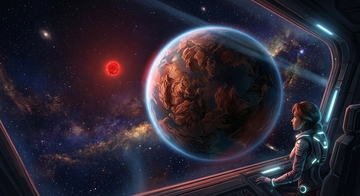
Imagine a planet in our cosmic neighborhood. In 2025, astronomers confirmed a world called HD 20794 d, a “super-Earth” orbiting a nearby Sun-like star. The star HD 20794 is about 20 light-years from Earth, so this planet is relatively close in space. Scientists say it lies in the star’s habitable zone, the region where liquid water could exist if the conditions are right. (science.nasa.gov)
HD 20794 d is much heavier than Earth. Researchers estimate its mass at about 5.8 times Earth’s mass, and one year on the planet lasts about 648 Earth days. To confirm it, astronomers studied tiny movements in the star caused by the planet’s gravity. They used data from the HARPS and ESPRESSO instruments in Chile and examined more than 20 years of observations. (science.nasa.gov)
Still, this does not mean the planet is truly comfortable for life. Its orbit is very stretched, not nearly round like Earth’s orbit. Because of this, HD 20794 d moves in and out of the habitable zone during its year. NASA says the planet may change from very hot conditions to deep cold, so it could be a world of fire and ice. “Potentially habitable” only means life is possible in theory, not that life is there. (science.nasa.gov)
Even so, the discovery is exciting. The star is bright and close, which makes HD 20794 d a very important target for future telescopes. In the years ahead, scientists hope to study planets like this more closely and search for gases in their atmospheres that might be linked to life. For now, HD 20794 d reminds us that the space near Earth may still hide amazing new worlds. (science.nasa.gov)