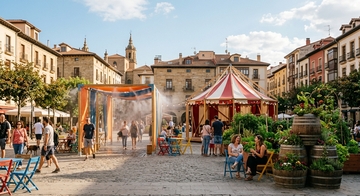
For six days in June 2026, the streets of Logroño in northern Spain looked very different. Concéntrico, an international architecture and design festival, placed more than 20 temporary structures in squares, gardens, empty land, and other public spaces. The festival, which began in 2015, uses the city as a laboratory for testing new ideas. (rtve.es)
One of the most surprising projects was a simple circus created by Chilean architect Smiljan Radić. It stood on an unused piece of land in the old part of the city. Inside the 20-meter-wide structure, visitors could sit on folding chairs and watch a short film. The project showed how a forgotten place could quickly become a space for people to meet and share an experience. (rtve.es)
Other projects focused on climate change. One installation offered shade, a light breeze, and cooling water mist when temperatures rose above 37 degrees Celsius. Another project used earth and old wine barrels, connecting modern architecture with La Rioja’s famous wine culture. There was also a shared garden where local people could plant seeds and think about nature in the city. (rtve.es)
These buildings were not designed to remain forever. However, temporary architecture can have a lasting effect. It allows citizens to use familiar places in new ways and helps city leaders test ideas without making an immediate, expensive decision. If a small structure makes a hot street cooler or brings life to an empty square, a similar idea may later become permanent.
Concéntrico shows that changing a city does not always require a huge building. Sometimes, a circus, a garden, or a shaded resting place is enough to help people imagine a better urban future.