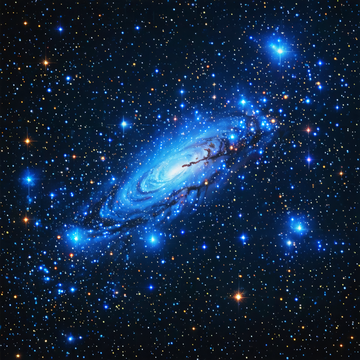
Look up at the night sky and imagine that many stars may have planets around them. In May 2026, NASA shared a new sky map from its TESS space telescope. This is TESS’s most complete view of the sky so far. NASA made the picture from 96 parts of the sky that TESS watched between April 2018 and September 2025. On the map, blue dots show 679 confirmed exoplanets, and orange dots show 5,165 possible planets, called candidates. (science.nasa.gov)
TESS is short for Transiting Exoplanet Survey Satellite. It studies one large area of the sky for about a month at a time, using four cameras. Scientists watch for a very small drop in a star’s light. This can happen when a planet moves in front of the star. That small change can help scientists find a world far beyond our solar system. (science.nasa.gov)
The map is beautiful, but it is also full of science. A bright band across the middle is our Milky Way galaxy. You can also see the Large and Small Magellanic Clouds, two nearby small galaxies. The exoplanet dots show that planets are not rare. They seem to be everywhere in the sky. Some TESS planets may be in the habitable zone, where liquid water could be possible. Others are much stranger: some may have strong volcanoes, some are being pulled apart by their stars, and some go around two stars instead of one. (science.nasa.gov)
This new map is only one part of a bigger story. NASA says that more than 6,200 exoplanets have been confirmed in total, and thousands more are still waiting to be checked. So, when you look up at the stars, you are not only seeing points of light. You may also be looking at a sky full of other worlds. (science.nasa.gov)