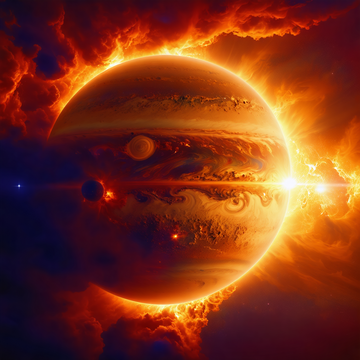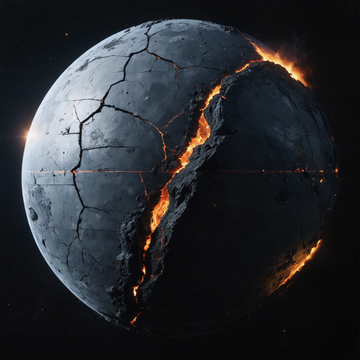
In May 2026, astronomers reported a major first for the James Webb Space Telescope: it directly studied the surface of a rocky exoplanet, not just its atmosphere. The target was LHS 3844 b, a super-Earth about 30% larger than Earth and about 48.5 light-years away. It races around a cool red dwarf star in only about 11 hours and is tidally locked, so one side always faces the star. That permanent dayside is extremely hot, around 1,000 K, or about 725°C. Using Webb’s MIRI instrument, the team measured the planet’s thermal emission at wavelengths from 5 to 12 micrometres. (mpia.de)
The exciting part is what that light revealed. Different rocks leave different patterns in infrared light, and the spectrum of LHS 3844 b is best explained by a dark, low-silica surface, such as basalt or olivine-rich mantle rock. The data do not match an Earth-like, granite-rich crust. They also argue against a surface covered in fresh bright powder, unless long-term “space weathering” has darkened that material. In simple terms, this distant world seems less like Earth and more like a hotter, harsher cousin of Mercury or the Moon. (nature.com)
These results may also tell us something about the planet’s past. On Earth, silica-rich crust forms through long geological processing and is closely connected with tectonic activity and water. Because LHS 3844 b seems to lack that kind of crust, Earth-like plate tectonics may not operate there, or may be ineffective. The researchers considered two main possibilities: a relatively fresh basaltic surface created by recent volcanism, or an older surface covered by darkened regolith produced by radiation and meteorite impacts. Since Webb did not detect expected volcanic gases such as sulfur dioxide, the team currently favors the older, more geologically quiet surface. (mpia.de)
For exoplanet science, this is a big step. It suggests that Webb can begin to do geology across interstellar distances, reading the history of a planet from its heat alone. The team has already obtained more JWST observations to test whether LHS 3844 b is covered by solid rock or powdery material more precisely. That means this strange, dark world may be only the beginning. (mpia.de)