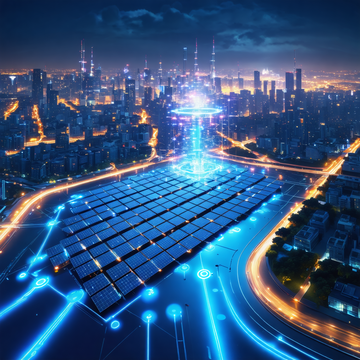
For most of the last century, power grids were designed as one-way systems: huge plants generated electricity, and consumers simply received it. Solar power and batteries are now rewriting that model. In 2025, global renewable capacity additions reached 800 GW, with solar PV alone surpassing 600 GW for the first time. In the same year, the world added 108 GW of new battery storage, and renewables supplied 33.8% of global electricity, edging past coal’s 33.0%. Clean power growth was so strong that it covered all net growth in global electricity demand in 2025. (iea.org)
This shift matters because solar changes the rhythm of the grid. When sunshine is abundant, supply can overwhelm demand in the middle of the day; later, when people return home and switch on lights, appliances, and air conditioning, the system needs power after sunset. The IEA notes that batteries are increasingly being built for longer discharge times, with more projects moving beyond two hours toward four hours or more. That trend is being helped by cheaper technology: average lithium-ion battery pack prices fell about 20% in 2024 and another 8% in 2025. In other words, the next-generation grid is not just producing cleaner electricity; it is learning how to move solar energy through time. (iea.org)
The United States offers a clear preview. The EIA expects 63 GW of new utility-scale generating capacity to be added in 2025, with solar and battery storage accounting for 81% of that total. Solar alone is expected to contribute 32.5 GW, while battery storage could add a record 18.2 GW. This is a remarkable change in grid planning: instead of building only more fuel-burning plants, utilities are increasingly pairing midday solar generation with storage that can strengthen reliability in the evening. (eia.gov)
The deeper redesign is digital as well as physical. By January 2025, virtual power plants had reached 33 GW across North America, according to the U.S. Department of Energy, linking rooftop solar, home batteries, smart thermostats, and flexible demand into coordinated systems. DOE says 80-160 GW could be deployed by 2030. At the same time, national labs and DOE are developing new reliability standards for inverter-based resources, because grids with large amounts of solar and batteries must be managed by software, forecasting, and fast controls as much as by wires and turbines. The future grid, then, may be more distributed, more responsive, and far more intelligent than the one it replaces. (energy.gov)