In 2026, the most intriguing question haunting American downtowns is no longer whether offices are empty, but which empty offices deserve a second life. The office market is still visibly strained: CBRE says the U.S. office vacancy rate was 18.6% in the first quarter of 2026, even as prime offices tightened to 12.7%. At the same time, conversions and demolitions are now removing more office space than new construction is adding, with 23.3 million square feet set to leave the market in 2025 versus 12.7 million square feet of expected new supply. In other words, the country is not witnessing the death of the office so much as a brutal sorting process: elite buildings recover, while weaker ones face reinvention. (cbre.com)
Housing is the obvious beneficiary. RentCafe, using Yardi Matrix data, found that office-to-apartment projects in the U.S. pipeline reached about 70,700 units in 2025, up dramatically from 23,100 in 2022 and equal to roughly 42% of all future adaptive-reuse apartments. New York led the nation with 8,310 planned units, followed by Washington, D.C. with 6,533 and Los Angeles with 4,388. Washington offers perhaps the clearest sign that conversions are becoming policy, not just improvisation: under the District’s Housing in Downtown program, officials said in January 2026 that 10 projects had been advanced, totaling 2,563 homes, while The Geneva alone will create 532 residences, including 60 permanently affordable units. (rentcafe.com)
And yet the romance of “turn offices into homes” collides with stubborn reality. Not every tower can be domesticated. Gensler’s conversion tool evaluates site context, building form, floor plate, envelope, and building services, underscoring how deeply architecture shapes feasibility. Brookings, meanwhile, argues that cities often lack clarity about what problem conversions are meant to solve—office distress, fiscal weakness, or the housing shortage itself—and that even the data on vacancies can be frustratingly opaque. That is why incentives matter. New York’s 467-m program grants tax exemptions for eligible rental conversions started by June 30, 2031, with more generous benefits for earlier projects. The scale of ambition is striking: the former Pfizer headquarters on East 42nd Street is being remade into more than 1,600 apartments, including over 400 affordable units, with completion projected for 2027. (gensler.com)
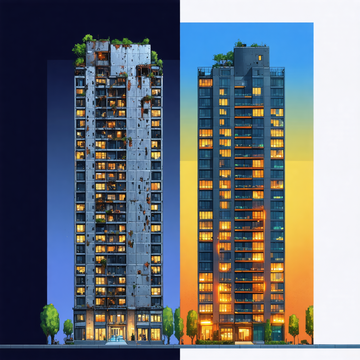
So, will vacant offices become housing? Yes—but selectively, expensively, and with heavy public guidance. America’s downtown future is unlikely to be a simple swap from desks to bedrooms; it will be a more surgical transformation, in which obsolete towers become homes while the best offices remain unmistakably offices. (cbre.com)