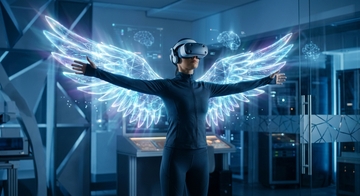
Imagine putting on a VR headset and seeing two large wings instead of your arms. When you move your arms, the wings move too. After some practice, could your brain begin to treat them like real body parts?
A study published in May 2026 suggests that this may be possible. Participants completed four VR training sessions over one week. They learned to control virtual wings by moving their arms and received visual information that made them feel as if they were flying. Researchers took brain scans before and after the training. (pubmed.ncbi.nlm.nih.gov)
The researchers focused on a brain area called the occipitotemporal cortex, or OTC. This area helps us recognize and understand body parts. After the VR training, the OTC reacted more strongly when participants saw pictures of wings. In the right side of the OTC, the brain’s response to wings also became more similar to its response to human arms. Communication between the OTC and areas related to touch and movement became stronger as well. (pubmed.ncbi.nlm.nih.gov)
However, this does not mean that the brain completely accepted the wings as natural human limbs. The researchers only found that the brain began to process them in a more body-like way. Still, the result shows how flexible the brain can be. It can change through learning and experience, even when the new “body part” is something humans have never naturally had.
In the future, this knowledge might help scientists design better virtual experiences or new systems for controlling artificial limbs. It also raises an exciting question: If we spend more time in virtual worlds, how might our idea of the human body change?