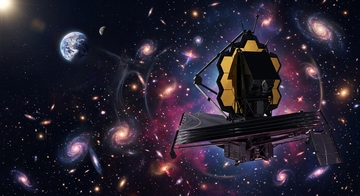
On August 30, 2026, NASA launched the Nancy Grace Roman Space Telescope. It is now traveling toward L2, a point about one million miles from Earth. During this three-month journey, engineers will test its systems and prepare it for science work. NASA expects to release Roman’s first images in early 2027. (nasa.gov)
Roman will study the “invisible universe.” Ordinary matter—including stars, planets, and people—makes up only about 5% of the universe. Scientists believe that dark matter makes up about 27%, while dark energy makes up about 68%. However, no one knows exactly what they are. (science.nasa.gov)
Dark matter cannot be seen directly, but it has gravity. Its gravity bends light from distant galaxies and slightly changes their shapes. Roman will study hundreds of millions of galaxies to find these small changes. If scientists map them carefully, they can learn where dark matter is located and how it has influenced the growth of galaxies. (science.nasa.gov)
Dark energy is even more mysterious. It may be causing the universe to expand faster and faster. Roman will observe distant exploding stars and map galaxies from different periods of cosmic history. These observations may show whether dark energy has changed over time. (science.nasa.gov)
Roman will also detect infrared light, which human eyes cannot see. Its main camera can take sharp pictures of an area at least 100 times larger than Hubble can view at once. This wide view will allow Roman to survey the sky up to 1,000 times faster than Hubble. (science.nasa.gov)
Roman may not “see” dark matter or dark energy like we see a star. Instead, it will look for their effects. Like a detective following clues, this new telescope could help us understand the hidden parts of our universe.