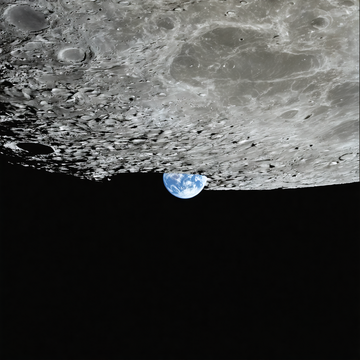
Imagine looking out of a spacecraft window and seeing Earth go down behind the Moon. That is called “Earthset.” On April 6, 2026, the Artemis II crew took this famous photo while flying around the Moon’s far side. NASA says the picture was taken at 6:41 p.m. EDT during a seven-hour lunar flyby, only about three minutes before the Orion spacecraft passed behind the Moon and lost contact with Earth for about 40 minutes. (science.nasa.gov)
The image is beautiful because Earth looks small and delicate. It appears as a thin crescent, partly bright and partly dark. On the sunlit side, white clouds and blue water can be seen over the Oceania region, while the dark side is in nighttime. The Moon, by contrast, looks huge and rough, with many craters and old basins. One NASA caption also notes that Ohm crater can be seen in the foreground. (science.nasa.gov)
Artemis II was an important mission. It launched from NASA’s Kennedy Space Center in Florida on April 1, 2026, aboard the Space Launch System rocket. The crew were NASA astronauts Reid Wiseman, Victor Glover, and Christina Koch, plus Canadian Space Agency astronaut Jeremy Hansen. Artemis II was the first crewed Artemis flight and the first crewed lunar flyby in more than 50 years. It was also the first time astronauts flew in the Orion spacecraft. (nasa.gov)
The mission ended on April 10, 2026, when the crew splashed down in the Pacific Ocean near San Diego after a journey of nearly 10 days. NASA says they traveled farther from Earth than any humans before. The Earthset photo is often compared with the famous “Earthrise” pictures taken by Apollo 8 in 1968. But this new image gives the old idea a fresh meaning: from deep space, our world looks small, quiet, and very precious. (nasa.gov)