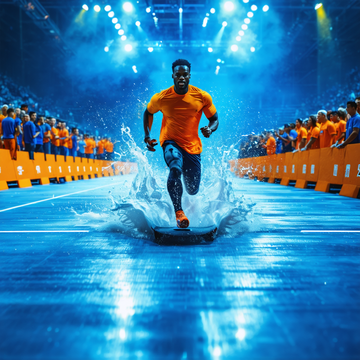
What makes HYROX New York striking is not just its spectacle, but its scale. The official event page says the 2026 edition will unfold across two weekends and eight race days, from May 28 to June 7, and will host 50,000 athletes—the largest HYROX event in North American history. For a discipline built on a brutally simple formula rather than on a century-old league structure, that is a remarkable milestone. (hyrox.com)
HYROX’s deeper significance lies in what it has standardized. Every race follows the same architecture: eight 1-kilometer runs, each followed by a workout station, with official timing and globally comparable results across divisions and age groups. That consistency turns ordinary gym training into something measurable, repeatable, and internationally legible. In other words, it gives recreational fitness a grammar of competition. HYROX itself argues that fitness has become many people’s primary sport, and its format is clearly designed for that cultural shift: accessible enough for first-timers, but precise enough for serious competitors chasing marginal gains. (hyrox.com)
The numbers suggest that this is no passing fad. PUMA said the 2024/25 HYROX season featured 74 events and more than 650,000 participants, a 100% year-on-year increase, and projected 1.3 million participants across more than 100 events in the 2025/26 season. Meanwhile, the National Strength and Conditioning Association announced a partnership with HYROX Academy in February 2026 to advance evidence-based coaching in hybrid fitness racing. When a fast-growing race series begins to attract not only athletes and sponsors, but also formal coaching and sport-science infrastructure, it starts to look less like a craze and more like an emerging sport ecosystem. (about.puma.com)
New York crystallizes that transition. NYU Langone Health’s expanded partnership includes on-site wellness and recovery resources from clinicians at its Sports Performance Center, while the race also sits near the end of the 2025/26 season, with pathways connected to the 2026 World Championships in Stockholm. The message is unmistakable: hybrid fitness is no longer confined to boutique gyms or social-media bravado. In New York, it arrives as mass participation, mass spectacle, and increasingly, institutional legitimacy. (nyulangone.org)