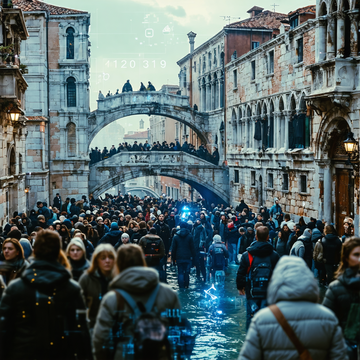
Venice is one of the world’s most beautiful cities, but beauty brings huge crowds. To protect the historic center, Venice introduced an access fee for day-trippers in 2024. In 2025, the system became stricter: on 54 busy days between April 18 and July 27, visitors aged 14 and over had to pay €5 if they booked at least four days early, or €10 if they booked later. The fee was charged from 8:30 a.m. to 4:00 p.m., while overnight guests and some other groups were exempt. (visitvenezia.eu)
But did it really stop overtourism? So far, the answer seems to be “not much.” Critics argued that the fee was too low to change people’s plans, and reporting based on official 2024 data said Venice actually received about 7,000 more visitors on average on fee days than on the same days a year earlier. In 2025, the average number of paying day visitors fell only slightly, and on the busiest day, Friday, May 2, 2025, 24,951 people still paid to enter the city. That suggests the fee may slow growth a little, but it does not remove the crowds. (theartnewspaper.com)
Still, the policy is not meaningless. City officials say it gives Venice useful data about visitor flows and helps cover public costs. AP reported that the 2024 pilot brought in €2.4 million, although running the system cost €2.7 million that year. The deeper problem is that tourism shapes almost everything in Venice: AP reported 48,283 residents in the historic center, but 51,129 tourist beds. When tourist beds outnumber local people, a small entrance fee alone cannot restore balance. (apnews.com)
So, can Venice’s entry fee stop tourist pollution? Probably not by itself. It is better seen as a tool, not a cure. It may encourage planning, collect data, and raise money, but Venice also needs broader answers, such as housing policies and stronger control of visitor pressure. The clearest sign of this mixed result is that Venice has kept the system for 2026 and expanded it again to 60 days. (visitvenezia.eu)