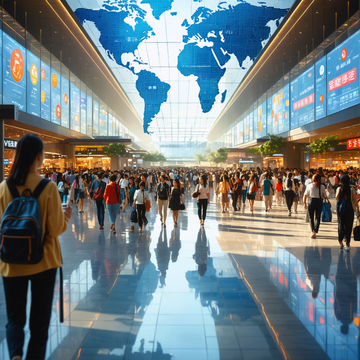
China’s widening visa-free regime is more than a technical change in border policy; it is an attempt to alter the rhythm of travel itself. By mid-February 2026, China had extended visa-free access to 79 countries, according to AP’s tally after the United Kingdom and Canada were added. China’s Foreign Ministry said ordinary-passport holders from those two countries could enter from February 17, 2026 for up to 30 days for business, tourism, family or friend visits, exchange, and transit, with the arrangement set to run through December 31, 2026. Official Chinese releases had already shown a rapid expansion to 76 visa-free countries by late January 2026, alongside a 240-hour transit-without-visa scheme for travelers from 55 countries through 65 entry ports. (apnews.com)
The practical consequence is a shift from ceremonial travel to frictionless travel. When paperwork shrinks, so does psychological distance: a business trip becomes easier to justify, a conference visit more spontaneous, and even a long layover can turn into a ten-day detour. The numbers suggest that this is not mere rhetoric. China recorded 697 million cross-border trips in 2025, a record high; international visitors made more than 82 million crossings, and nearly 30.1 million arrivals were visa-free, up 49.5 percent year on year and accounting for 73.1 percent of international arrivals. In 2024, more than 20 million foreign visitors entered China without a visa, more than double the previous year. (english.scio.gov.cn)
For international exchange, the deeper significance may lie in what visas used to interrupt: serendipity. Researchers, tourists, entrepreneurs, and students do not simply “consume” a country; they test their assumptions against reality. A less cumbersome border makes room for more minor but meaningful encounters—in museums, cafés, trade fairs, university seminars, and family homes. The policy is not unlimited: many arrangements are still time-limited, and visa-free entry does not cover work, study, or journalism. Even so, the direction is unmistakable. China is trying to make mobility easier, more ordinary, and more frequent; and when movement becomes ordinary, mutual understanding often stops being a diplomatic slogan and starts becoming a social habit. (english.www.gov.cn)