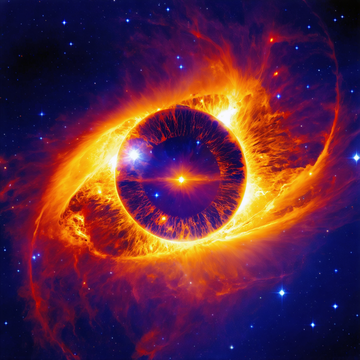
In March 2026, ESA and NASA released a new view of the Cat’s Eye Nebula, also called NGC 6543. This famous object is in the constellation Draco. The new image combines two powerful space telescopes: Hubble looks closely at the bright center, and Euclid shows the much wider area around it. Together, they show one of the most complex and beautiful remains of a dying star. (esa.int)
Hubble’s sharp image shows many small details: round shells, thin jets of fast gas, and dense knots shaped by shock waves. Scientists think these patterns record different times when the star threw material out into space. Euclid, which was built mainly to study the distant Universe and dark matter, caught the Cat’s Eye Nebula in its Deep Field North survey. Its wider view shows a larger halo and broken ring of gas around the nebula, with many faraway galaxies in the background. (science.nasa.gov)
So, what happens when a star dies? For a star like our Sun, the star first grows into a red giant. Then it pushes its outer layers away. The hot core stays behind and becomes a white dwarf. Ultraviolet light from this hot core makes the lost gas glow, creating what astronomers call a planetary nebula. The name is a little strange: these objects have nothing to do with planets. They were given that name because they looked planet-like in early telescopes. In fact, the Cat’s Eye Nebula helped astronomers realize in 1864 that these objects are made of glowing gas. (science.nasa.gov)
The Cat’s Eye Nebula is not only pretty. It is also a picture of the far future of stars like our Sun. NASA says our Sun will one day lose its outer gas and leave behind a white dwarf too, though not for about 5 billion years. Hubble helps us see the fine details of stellar death, while Euclid reminds us that even one dying star can shine in a sky full of countless galaxies. (science.nasa.gov)