Plants cannot shout when they are thirsty, overheated, or otherwise under pressure. Yet in a sense, they do send out an optical distress signal. During photosynthesis, part of the sunlight absorbed by chlorophyll is re-emitted as an extremely faint fluorescence, invisible to the human eye. Because that glow changes with environmental conditions and plant health, scientists can use it as a remarkably direct clue to how well vegetation is functioning. NASA has even noted that fluorescence can reveal stress before leaves visibly turn brown or yellow. (esa.int)
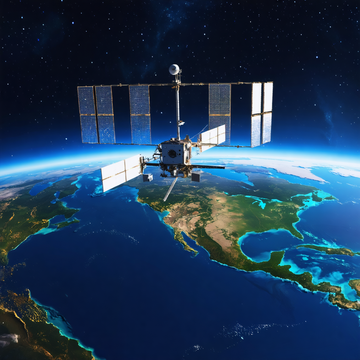
That is the scientific promise behind ESA’s FLEX mission, short for Fluorescence Explorer. FLEX is ESA’s eighth Earth Explorer mission, and its job is to measure vegetation fluorescence on a global scale and translate it into information about photosynthetic activity and plant stress. Its key instrument, FLORIS, is a fluorescence imaging spectrometer operating across the 500–780 nm range. According to ESA, the mission is designed to generate monthly global maps at a spatial resolution of 300 m × 300 m, giving researchers a new way to study plant performance and its links to the carbon and water cycles. (esa.int)
What makes FLEX especially exciting now is that it is no longer a remote idea. In April 2026, ESA showed the completed satellite to the media in Cannes, France, in what the agency described as its last public appearance before shipment to Europe’s Spaceport in French Guiana. ESA’s current mission information lists launch for September 2026 on a Vega-C rocket, and FLEX is due to fly on the same launch as Copernicus Sentinel-3C. Once in orbit, FLEX will operate in tandem with Sentinel-3, which will provide complementary measurements of the atmosphere and Earth’s surface. (esa.int)
Why does this matter? Because “green” does not always mean “healthy.” Traditional satellite images often show how much vegetation is present, but fluorescence offers a more physiological view: it helps scientists observe how actively plants are actually photosynthesising. That could improve drought and crop-stress monitoring, while also sharpening our understanding of how much carbon plants absorb from the atmosphere. In other words, FLEX may let us read the hidden light of the biosphere—and hear the quiet SOS of stressed vegetation before the damage becomes obvious. (esa.int)