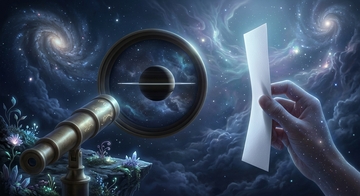
Have you ever seen something important arrive before the place around it was ready? In the early universe, that may have happened on a huge scale. Since late 2022, the James Webb Space Telescope has been finding strange objects called little red dots, and many of them seem to hide growing black holes. One of the most famous is Abell2744-QSO1, seen from just 700 million years after the Big Bang. It is tiny, only about 1,300 light-years across, but a galaxy cluster in front of it works like a giant lens, making it easier for Webb to study. (science.nasa.gov)
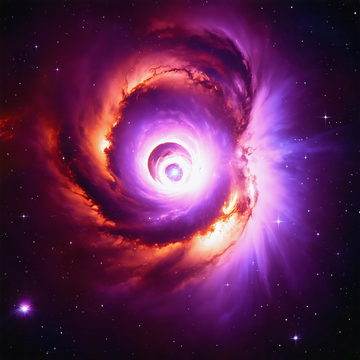
Then came the surprise. Webb mapped the gas moving around the center of QSO1 and found a clean orbit pattern, much like planets moving around the Sun. That gave astronomers the first direct black hole mass measurement from within the universe’s first billion years. The answer was shocking: the black hole is about 50 million times the mass of our Sun, and it makes up at least two-thirds of the whole system. The gas also looks almost untouched, mostly hydrogen and helium, with very few heavier elements. That suggests there may not have been many stars there yet. (science.nasa.gov)
Imagine visiting a brand-new neighborhood and finding a huge shopping mall already open while most of the houses are still missing. That is the picture QSO1 gives us. Instead of a galaxy building a black hole slowly, this black hole may have been born big and only later started building a galaxy around itself. Scientists are now testing ideas like direct collapse or another very early “heavy seed” origin. (science.nasa.gov)
So maybe the universe does not always follow the order we expect. Sometimes, it may build the engine before the ship. (esawebb.org)