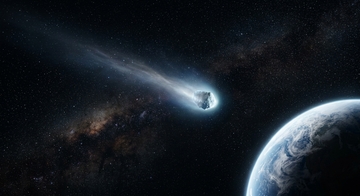
For nearly 30 years, astronomers believed that an object called 1998 SH2 was an asteroid. It was discovered in 1998 and travels around the Sun once every four and a half years. It did not have the bright tail that people usually connect with a comet, so it looked like an ordinary space rock.
However, something strange happened in August 2025. The object passed safely about 3 million kilometers from Earth. NASA scientists planned to study it with radar, but it was not in the place where they expected to find it. Gravity from the Sun and planets could not fully explain this difference. (jpl.nasa.gov)
The researchers thought that gas might be escaping from the object. Comets contain ice mixed with rock and dust. When sunlight heats the ice, it changes into gas and moves out into space. This can push a comet slightly, like a very small rocket engine. It can also produce a bright cloud and a tail. In the case of 1998 SH2, however, the amount of gas and dust was so small that earlier telescopes could not easily see it.
Powerful telescopes in Hawaii and Chile were used to take a closer look. Their images finally showed a weak but clear tail. This confirmed that 1998 SH2 was really an active comet. It has now received an additional name: P/1998 SH2. (jpl.nasa.gov)
This discovery is important for planetary defense. If scientists mistake a comet for an asteroid, their predictions about its future path may be less accurate because escaping gas can change its movement. By continuing to observe near-Earth objects carefully, astronomers may discover other hidden comets—and better understand whether any of them could become dangerous to Earth.