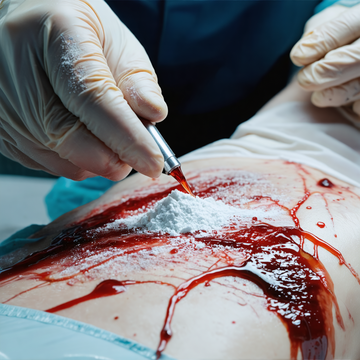
Imagine a doctor or rescue worker facing a deep wound. In that moment, even a few seconds can save a life. A new technology from KAIST in South Korea may help do exactly that. In a study published in Advanced Functional Materials on March 16, 2026, the team described a powder called AGCL that acts like an artificial blood clot. When the powder touches blood, it reacts with calcium ions and turns into a sticky hydrogel in about one second, quickly sealing the wound. (pure.kaist.ac.kr)
The idea is simple but powerful. The powder contains alginate, gellan gum, chitosan, and a crosslinker. Two of these materials help the gel form very fast, while chitosan also interacts with blood components to support hemostasis, or bleeding control. The powder can absorb blood equal to about 7.25 times its own weight, and it has strong adhesion of more than 40 kPa, so it can stay in place even in difficult, high-pressure bleeding situations. (pure.kaist.ac.kr)
This is important because ordinary patch-type products are not easy to use on deep, large, or uneven wounds. A powder can reach places that a flat patch cannot. According to KAIST, the new material also stayed stable for up to 24 months in normal storage conditions, which could make it useful in emergencies, disasters, or even on battlefields where medical tools must be easy to carry and use fast. (pure.kaist.ac.kr)
The early results are promising. In lab tests, AGCL showed low red-blood-cell damage, high cell compatibility, and very strong antibacterial effects. In animal experiments, it reduced blood loss and shortened bleeding time compared with TachoSil, a clinical benchmark, and it also supported wound healing, including new blood vessel growth and collagen formation. However, the reported results so far come from laboratory and animal studies, so future human studies will be important. Still, this “artificial clot” shows how smart materials could make emergency care much faster in the near future. (pure.kaist.ac.kr)