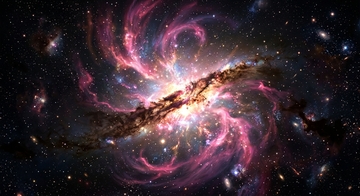
On 21 April 2026, ESA and the Euclid Consortium launched “Space Warps – ESA Euclid” on the Zooniverse platform, turning the search for warped galaxies into a global citizen-science project. Volunteers are asked to spot strong gravitational lenses: rare systems in which the gravity of a foreground galaxy or galaxy cluster bends spacetime so dramatically that the light from a more distant galaxy is stretched into arcs, multiple images, or even a near-perfect Einstein ring. In other words, the universe itself becomes a giant natural telescope. (esa.int)
What makes this project especially modern is the partnership between AI and human intuition. Euclid sends about 100 GB of data back to Earth every day, far too much for astronomers to inspect one image at a time. For the new campaign, around 300,000 images have been pre-selected by AI from a staggering 72 million galaxies in Euclid’s upcoming Data Release 1. The data are not public yet, so participants are effectively getting an early look at discoveries in progress. Some images even include simulated lenses, both to train volunteers and to measure how reliably the crowd can identify the real thing. (esa.int)
This human-machine strategy has already proved its value. In March 2025, researchers built a first catalogue of 500 galaxy-galaxy strong lens candidates from only 0.04% of Euclid’s data, and almost all of them were previously unknown. That catalogue emerged from a chain of AI screening, citizen-science inspection, expert vetting, and detailed modelling. ESA says the mission could reveal about 7,000 candidates in its major 2026 cosmology release and roughly 100,000 by the end of the mission—around 100 times more than are currently known. (esa.int)
The stakes are enormous. Euclid, launched in July 2023 and conducting routine science observations since 14 February 2024, is designed to map billions of galaxies across more than a third of the sky and out to 10 billion light-years. Strong lenses help astronomers “weigh” galaxies and clusters, trace dark matter, and study how cosmic expansion has changed over time. So when ordinary people click through Space Warps, they are not just playing with beautiful images—they are helping investigate the dark universe itself. (esa.int)