The 2026 European Union Prize for Contemporary Architecture / Mies van der Rohe Awards, announced on April 16, 2026 in Oulu, Finland, offered a striking message: the most compelling architecture today may be the kind that resists the reflex to demolish. Out of 410 nominated works, the main Architecture Award went to Charleroi Palais des Expositions in Belgium, while the Emerging Award went to Temporary Spaces for the Slovenian National Theatre Drama in Ljubljana. More important than the names, however, was the jury’s shared conclusion: contemporary architecture must “work with the existing,” treating transformation, repair, and reuse not as compromises, but as central design strategies. (eumiesawards.com)
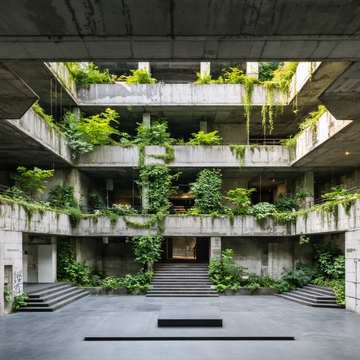
Charleroi Palais des Expositions embodies that ethic with unusual clarity. Rather than replacing a vast 1950s convention centre, the architects reassessed what could be kept, opened the central hall, stripped façades to create a covered outdoor space, and reduced the thermal envelope instead of expanding it. The project even turned demolished fragments into urban furniture and transformed the dark interior into a three-level garden. Its intelligence lies not in spectacular novelty, but in disciplined restraint: the building survives by being reinterpreted, not erased. (eumiesawards.com)
The Slovenian theatre project makes a parallel argument from a different angle. Installed in former industrial halls from the 1960s, it created temporary performance spaces for the national theatre during the renovation of its historic home. The work was completed within a limited budget and a ten-month schedule, using recycled or reusable materials; notably, the large CLT panels can later be dismantled and used again. Here, “temporary” does not mean disposable. Instead, impermanence becomes an architectural virtue: flexible, frugal, and culturally generous. (eumiesawards.com)
What the 2026 EUmies Awards reveal, then, is a new architectural imagination shaped by scarcity, climate responsibility, and respect for what already exists. The hero of these projects is not the tabula rasa, but the inherited structure. In that sense, the awards point beyond style toward an ethic: responsible regeneration as a mature, even hopeful, answer to Europe’s environmental, social, and economic pressures. (eumiesawards.com)