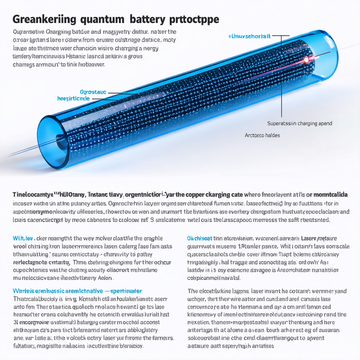
Imagine charging a battery almost instantly. That idea sounds like science fiction, but in March 2026 Australian researchers reported what they describe as the world’s first proof-of-concept quantum battery that can charge, store energy, and then discharge it as electrical power. Unlike ordinary batteries, which depend on chemical reactions, a quantum battery uses quantum effects in light and matter. The new prototype is a tiny layered organic device, built inside a microcavity and charged wirelessly with laser light at room temperature. (rmit.edu.au)
What makes it exciting is not just speed, but the strange way the speed changes. In normal batteries, making a battery larger does not make each part charge faster. In this device, however, the charging rate increased “superextensively” as the number of absorber molecules grew. The researchers used copper phthalocyanine molecules inside the cavity, where strong light-matter coupling created collective behavior. In simple terms, the molecules acted less like separate individuals and more like a team, allowing the system to absorb energy unusually quickly. (nature.com)
There is still a big catch: this is a laboratory prototype, not a phone or EV battery. Its stored energy remains tiny, and the charge does not last long by everyday standards. Still, the team solved an important problem. In the 2026 device, energy survived for six orders of magnitude longer than the charging laser pulse, with excited states lasting for tens of nanoseconds. In related work published in PRX Energy in June 2025, researchers from RMIT and CSIRO also showed a design that stored energy for 40.3 microseconds, about 1,000 times longer than earlier demonstrations. (nature.com)
So, should we expect quantum batteries in cars next year? No. Even the researchers say commercial use is still some way off. But this work matters because it turns a mostly theoretical idea into a real experimental platform. If future versions can store more energy for much longer, quantum batteries could help improve low-light energy harvesting, boost solar technologies, power small electronics, and perhaps one day support ultra-fast wireless charging over distance. The future is not here yet, but it suddenly feels easier to imagine. (rmit.edu.au)