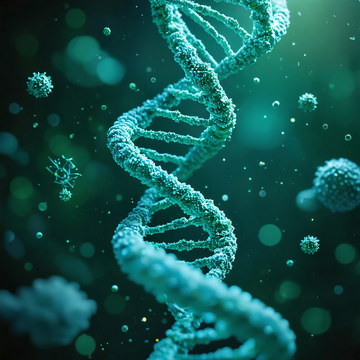
Can AI write DNA? In a limited but astonishing sense, yes. On March 4, 2026, Nature published the Evo 2 study, describing a genome foundation model trained on about 9 trillion DNA base pairs from more than 128,000 genomes across the tree of life. Built by Arc Institute, NVIDIA, and academic collaborators, Evo 2 can analyze sequence patterns at single-nucleotide resolution across contexts as long as 1 million base pairs. (nature.com)
What makes Evo 2 remarkable is that it does not merely read DNA; it can also generate it. According to the Nature paper, the model can complete genes and produce genome-scale sequences resembling human mitochondrial DNA, the minimal bacterium Mycoplasma genitalium, and even long yeast chromosomal regions. It also predicts the effects of mutations, including clinically important BRCA1 variants, without task-specific fine-tuning. In other words, Evo 2 treats genomes less like static code and more like a language with grammar, style, and long-range structure. (nature.com)
Still, “AI creates life” would be an exaggeration. Evo 2 does not conjure living organisms out of thin air. In practice, the frontier looks more like a read-write-test loop: AI proposes sequences, researchers synthesize them, and experiments reveal whether biology accepts the design. Arc reports that Evo 2-guided regulatory DNA was synthesized and tested in cells, with some designs producing the predicted chromatin-accessibility patterns. The group also reported the first AI-designed, experimentally validated bacteriophages; after supervised fine-tuning and lab screening, 16 of 285 tested designs successfully propagated in bacteria. (arcinstitute.org)
That is why Evo 2 feels like a turning point. It suggests that synthetic biology may shift from slow trial-and-error toward guided exploration of genetic possibility. At the same time, the safety question is impossible to ignore. Arc says eukaryotic viruses were excluded from Evo 2’s training data, and red-team tests found that attempts to generate pathogenic human viral proteins produced effectively random results. So yes, AI can now “write” DNA—but only under constraints, and only with human judgment, laboratory validation, and serious biosafety guardrails. (arcinstitute.org)