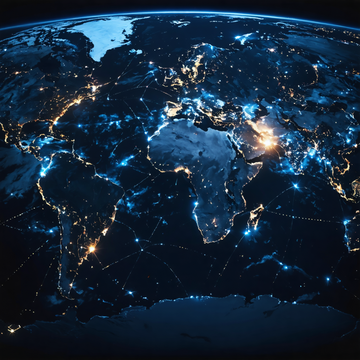
Seen from space, Earth at night looks calm and beautiful. But a new Nature study published on April 8, 2026 shows that the planet’s lights are becoming less steady than many people assumed. Using 1.16 million daily NASA Black Marble images from 2014 to 2022, researchers found that night-time lighting is not simply getting brighter year by year. Instead, brightening and dimming often happen in the same places, sometimes again and again. On average, each location that changed experienced 6.6 separate shifts over nine years. Globally, brightening added light equal to 34% of the 2014 baseline, but dimming cancelled 18% of that, leaving a net rise of 16%. (nature.com)
Why is human activity at night becoming so unstable? One reason is that artificial light reflects many different parts of society at once: city growth, factory activity, transport, energy supply, public policy, and even crisis. The study shows that some changes are gradual, such as urban expansion, rural electrification, or LED replacement programs. Others are abrupt, including power cuts after hurricanes, destruction during armed conflict, and economic collapse. The maps captured examples ranging from urban growth in China and India to dimming in Ukraine during war, in Puerto Rico after hurricane-related outages, and in Venezuela during long-term economic decline. (nature.com)
The instability has grown stronger since 2020. According to the paper, this rise in volatility matches a period shaped by COVID-19 lockdowns, faster LED transitions, dark-sky and energy-saving policies, and the European energy crisis after Russia’s full-scale war against Ukraine. In other words, the night side of Earth now behaves almost like a social “heartbeat,” reacting quickly to shocks and adjustments in human life. (nature.com)
There is also an important warning: satellites do not capture everything perfectly. NASA’s Black Marble products correct for clouds, moonlight, atmosphere, terrain, and stray light, but VIIRS is still weak at detecting blue-rich white LED light. That means some real changes in how bright the night feels to people and ecosystems may be larger than the satellite record suggests. This matters because artificial light at night is not only a sign of development; recent research shows it can also alter ecosystem metabolism and increase ecosystem respiration. (ladsweb.modaps.eosdis.nasa.gov)