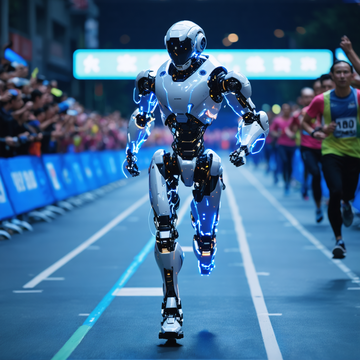
On April 19, 2026, Beijing turned a half marathon into a scene from the future. More than 100 robot teams joined the Beijing E-Town Half-Marathon and Humanoid Robot Half-Marathon, while about 12,000 human runners raced on parallel tracks for safety. The course was 21.0975 kilometers long and included slopes, curves, and narrow sections, so it tested more than simple speed. (english.beijing.gov.cn)
The star of the day was a robot called Shandian, which means “Lightning.” It was entered by Team Monkey King, and AP and Reuters reported that it was developed by the Chinese smartphone brand Honor. The robot finished in 50 minutes and 26 seconds. That was faster than the men’s human half-marathon world record of 57 minutes 20 seconds, set by Uganda’s Jacob Kiplimo in Lisbon in March 2026. Only one year earlier, the winning robot in the first Beijing race needed about 2 hours 40 minutes. (english.beijing.gov.cn)
Why did this matter so much? First, many robots were no longer simply guided from the side. Reuters reported that nearly half of the entrants ran the course autonomously. Official race rules also gave remote-controlled robots a 20% time penalty, so independence was a big part of the competition. Engineers said the winning robot used long legs modeled on top human runners and a liquid-cooling system connected to smartphone technology. (english.beijing.gov.cn)
Still, running fast does not mean robots are ready to do every job. Reuters noted that factories need more than strong legs: robots also need better hands, better vision, and better judgment in messy real spaces. Even so, the Beijing race showed something important. AI robots are moving from short demonstrations to long, difficult tasks in the real world. They may not replace people tomorrow, but they can already run much farther—and much faster—than many people expected. (wtaq.com)