Paris is about to lose one of its strangest and most famous views. The Paris Montparnasse Observatory, at the top of the 210-meter tower, will close to the public on March 31, 2026, before a long redevelopment begins. That closure matters because the tower is not just a lookout point: since its opening in 1974, it has welcomed more than 30 million visitors, while the tower itself, completed in 1973, has remained one of the most argued-over elements in the Paris skyline. (tourmontparnasse56.com)
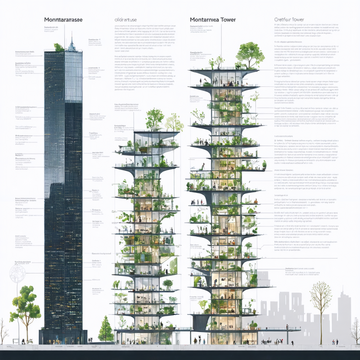
The tower’s makeover is designed to change not only how it works, but how it feels from a distance. The winning scheme by Nouvelle AOM will replace the current dark façade with clearer glass, making the building appear lighter and more transparent against the sky. The lower levels are planned to gain planted balconies and “hanging gardens,” while a greenhouse at the top is expected to raise the tower by about 20 meters. The renovation also aims to improve energy performance, turning a much-criticized black monolith into something greener, brighter, and less visually aggressive. (tourmontparnasse.paris)
Yet the biggest change may happen at street level. Renzo Piano Building Workshop is redesigning the commercial center and CIT Tower at the base as a more open, walkable district, with transparent ground floors, new pedestrian routes, a planted central piazza, and a mix of cafés, terraces, cultural spaces, sports facilities, offices, shops, and student housing. Official plans say the new routes will reconnect Rue de Rennes, Gare Montparnasse, and neighboring streets across three arrondissements. The city and the site’s owners signed a protocol agreement on January 7, 2026, while wider public-space works around Montparnasse include more trees, calmer traffic, and major improvements to nearby streets and the station forecourt through 2028 and 2030. (rpbw.com)
So, will Paris’s landscape be reborn? Probably not through a single spectacular gesture, but through a quieter shift in character. The new Montparnasse is meant to be less sealed off, less hostile to pedestrians, and less heavy on the skyline. In that sense, the redevelopment is trying to do something very Parisian: not erase the past, but teach an awkward landmark how to live with the city around it. (rpbw.com)