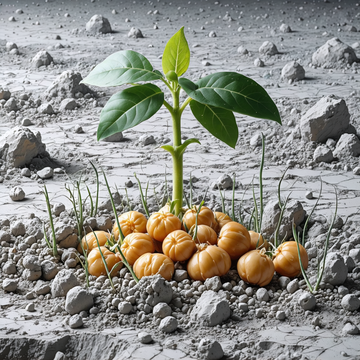
Can plants grow in moon soil? The newest research says: maybe, but not in raw moon dust alone. The Moon’s surface material is called regolith. It has no living microbiome, very little organic matter, poor water movement, and metal-rich chemistry that can stress plants. In 2022, NASA-supported scientists grew Arabidopsis in real Apollo lunar samples for the first time, but the plants were weaker than those grown in Earth soil or in a lunar simulant. (nasa.gov)
A more hopeful result came in March 2026. In a Scientific Reports study, researchers grew chickpeas in simulated lunar regolith mixed with vermicompost, a rich compost made by earthworms, and added helpful root fungi called arbuscular mycorrhizal fungi, or AMF. With this support, chickpea plants produced seeds in mixtures containing up to 75% lunar simulant. The number of seeds dropped as the amount of simulant increased, but many of the seeds that did form were similar in weight to seeds from control plants. (nature.com)
The result is exciting because chickpeas are a nutritious food: they are rich in protein and minerals, and they do not need huge amounts of water. But the experiment also showed the limits of space farming. Plants grown in 100% lunar simulant died before flowering. Even so, AMF helped a lot: in pure simulant, treated plants lived about two weeks longer than untreated plants, and the fungi were able to colonize roots even under these harsh conditions. (nature.com)
Researchers are already moving forward. A follow-up paper published in December 2025 tested 16 chickpea genotypes in lunar simulant amended with compost, AMF, and nitrogen-fixing bacteria. Many lines showed strong early establishment, often between 80% and 100%, which suggests that plant breeding could become an important part of future lunar agriculture. So, can crops grow in moon soil? Not yet in simple, untreated regolith. But with microbes, compost, and smart crop selection, the idea is starting to look much more real. (frontiersin.org)