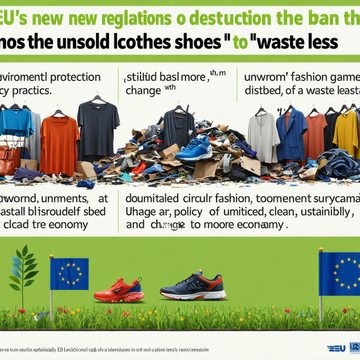
Imagine a brand-new jacket that is never worn, never loved, and never even reaches a real owner. Instead, it is thrown away or burned. That sounds shocking, but it has been part of the fashion business for years. Now the European Union is trying to stop it. On February 9, 2026, the European Commission adopted new measures under the Ecodesign for Sustainable Products Regulation, or ESPR, to prevent the destruction of unsold apparel, clothing accessories, and footwear. The Commission says that each year in Europe, about 4% to 9% of unsold textiles are destroyed before anyone uses them, creating around 5.6 million tonnes of CO2 emissions. (environment.ec.europa.eu)
These new rules are not just a simple ban. They are part of a wider plan to change how products are designed and sold. The ESPR entered into force on July 18, 2024. Under the new timetable, large companies will no longer be allowed to destroy unsold clothes and shoes from July 19, 2026, and medium-sized companies will follow on July 19, 2030. The EU has also created a standard format for companies to report how many unsold goods they discard, with that disclosure format applying from February 2027. (commission.europa.eu)
The bigger story is that Europe is moving from “sell more” to “waste less.” In April 2025, the Commission’s first ESPR working plan chose textiles as one of its priority sectors for future ecodesign rules. Then, on October 16, 2025, the revised Waste Framework Directive entered into force. It requires every EU country to create extended producer responsibility systems for textiles and footwear, meaning producers must help pay for collection, sorting, recycling, and waste management. Those fees can be linked to how durable and recyclable a product is. (commission.europa.eu)
For shoppers, this may mean a future with fewer “throwaway” clothes and more repair, resale, donation, and reuse. Of course, a ban alone will not solve every problem in fast fashion. But it sends a clear message: making too much and destroying the leftovers is no longer acceptable. If these rules work well, fashion in Europe may become not only more stylish, but also more responsible. (environment.ec.europa.eu)