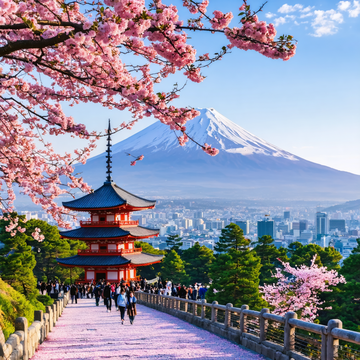
Every spring, many people visit Fujiyoshida, a city near Mount Fuji, to see a famous view: pink cherry blossoms, a red pagoda, and Japan’s highest mountain in the background. But in February 2026, the city decided to cancel its annual cherry blossom festival at Arakurayama Sengen Park. The festival had started about ten years ago to bring more visitors, yet the crowds became too large for the neighborhood. (apnews.com)
City officials said that in recent years more than 10,000 tourists a day came to the area during blossom season. For local people, the problem was not only the number of visitors. Residents complained about heavy traffic, trash, cigarette butts, and tourists entering private property to ask for toilets. Some visitors even relieved themselves in people’s yards. Officials said the area is mainly a normal residential neighborhood, so protecting daily life had to come first. (apnews.com)
Even after the festival was canceled, the blossoms still bloomed, and the tourists still came. In early April 2026, the city strengthened safety rules instead of holding the event. From April 1, it increased security, limited traffic around the park, blocked tour buses from entering some areas, and asked many visitors to walk. The city also used timed entry at the observation deck, banned tripods and other space-taking camera equipment there, and set up 16 temporary toilets. One city document says about 50 security guards were used during the stronger control period. (apnews.com)
This small story is also a big Japan story. According to the Japan National Tourism Organization, Japan welcomed 42,683,600 international visitors in 2025, the highest yearly total on record. Tourism brings money and jobs, so many towns want visitors. But Fujiyoshida shows the hard question: how can a beautiful place welcome the world without hurting the people who live there? The cherry trees are still beautiful, but now the town is asking for something else too—respect. (jnto.go.jp)