After more than 50 years, humans are getting ready to travel around the Moon again. Artemis II will be NASA’s first crewed Artemis mission and the first time astronauts fly on the Space Launch System rocket and Orion spacecraft. The mission is planned as a 10-day lunar flyby. As of March 20, 2026, NASA had rolled the rocket to Launch Pad 39B in Florida, and the agency said launch could come as soon as April 1, with more chances in the first week of April. (nasa.gov)
The four astronauts on Artemis II are Reid Wiseman, Victor Glover, Christina Koch, and Jeremy Hansen of the Canadian Space Agency. NASA says this historic crew includes the first woman, the first person of color, and the first Canadian on a lunar mission. That makes Artemis II important not only for science and engineering, but also for representation. For many people, this mission shows a new chapter in space exploration. (nasa.gov)
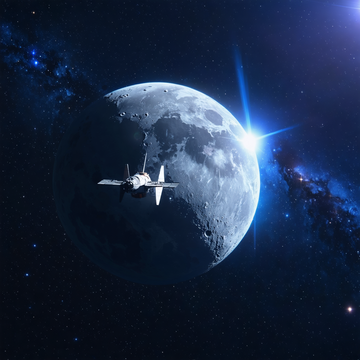
Artemis II is not a moon-landing mission. Instead, Orion will first circle Earth, giving the crew and mission teams time to check the spacecraft’s systems and practice manual control. Then the spacecraft will head toward the Moon on a free-return path, using the gravity of Earth and the Moon to help bring the crew safely home. NASA says the astronauts will travel about 4,600 miles beyond the far side of the Moon, farther than humans have gone in more than half a century. (esa.int)
The mission is also a test for the future. During the flight, the crew will observe and photograph the Moon from a unique distance, helping scientists prepare for later surface missions. Artemis II will also carry experiments such as AVATAR, which uses tiny “organ chips” to study how deep-space radiation and microgravity affect the human body. In other words, this exciting trip around the Moon is also practice for something even bigger: living and working farther from Earth, and one day going on to Mars. (science.nasa.gov)