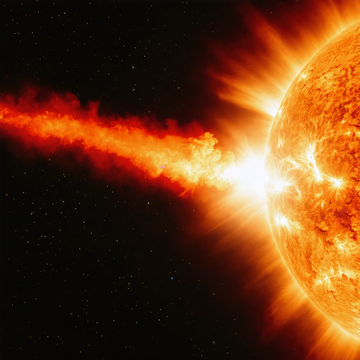
In early April 2026, a comet named C/2026 A1 (MAPS) flew very close to the Sun. Many people hoped it would survive and shine brightly. But it did not. On April 16, 2026, NASA reported that the comet was destroyed, probably several hours before its closest pass on April 4. NASA said the comet came to about twice the Earth-Moon distance from the Sun, which was still far too hot for it to survive. (science.nasa.gov)
NASA and ESA’s SOHO spacecraft watched the comet with a special instrument called a coronagraph. This instrument blocks the Sun’s bright light, so scientists can see faint objects nearby. SOHO saw the comet go in, but only a cloud of dust came out on the other side. Another NASA mission, STEREO, looked from a different angle and showed that the comet was swinging around the Sun as it broke apart. NASA’s PUNCH mission also photographed MAPS before its final trip. PUNCH is a group of four small satellites that studies how the Sun’s outer atmosphere becomes the solar wind. (science.nasa.gov)
This was not just a sad ending. It was also useful science. Comets are made of old ice, dust, and rock. They are like time capsules from the early solar system. When a comet breaks up near the Sun, scientists can learn more about what is inside it and how comets were formed long ago. NASA says events like this help researchers study both comets and the Sun’s powerful heat. (science.nasa.gov)
MAPS was discovered on January 13, 2026, by a telescope in Chile used by the MAPS program, led by amateur astronomers Alain Maury, Georges Attard, Daniel Parrott, and Florian Signoret. It was part of the Kreutz family, a group of “sungrazing” comets that pass very close to the Sun and are thought to be pieces of a much larger comet that broke apart centuries ago. So MAPS is gone now, but its short and dramatic life gave scientists a rare chance to watch a comet die in real time. (science.nasa.gov)