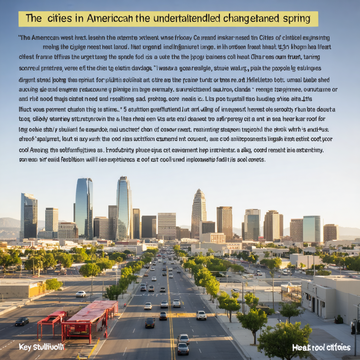
In March 2026, “spring” suddenly looked a lot like summer in the American West. Parts of the Southwest hit 112°F, smashing U.S. March heat records, and San Francisco experienced its hottest March in at least two decades. According to scientists cited by AP, a rapid analysis by World Weather Attribution found that heat this extreme in March would have been virtually impossible without human-caused climate change. The shock was not only the temperature itself, but also the timing: cities were facing dangerous heat months earlier than many people expected. (apnews.com)
This is why people are talking more seriously about “heat-resilient cities.” A heat-resilient city is a city designed to protect people when temperatures rise. That matters because cities trap heat. The World Health Organization says the urban heat island effect can raise average city-center temperatures by 3–5°C above nearby countryside, while heatwaves also put pressure on health services, water, energy, and transportation systems. In other words, extreme heat is not just uncomfortable; it can weaken the basic systems that keep urban life running. (who.int)
Phoenix offers one of the clearest examples of how cities are responding. Its 2026 Heat Response Plan includes 23 specific actions across eight strategies to prevent illness and death from indoor and outdoor heat. The city’s Shade Phoenix Plan treats shade as essential infrastructure and includes 36 actions, with funding for more than 27,000 new trees and 550 new shade structures over five years. Phoenix has also applied more than 140 miles of “cool pavement,” and city research says this material can reduce summer surface temperatures by up to 12°F during the day. (phoenix.gov)
Other cities are moving in the same direction. Miami-Dade says it appointed the world’s first Chief Heat Officer, set a goal of 30% tree canopy by 2030, and helped push cool-roof requirements for low-slope commercial roofs in South Florida. More broadly, the U.S. EPA says cool-roof rules already appear in at least 13 cities and counties, seven states, and Washington, D.C. At the global level, WRI’s Cool Cities Lab is scheduled to launch in March 2026 to help cities identify their hottest neighborhoods and compare solutions such as trees, cool roofs, and shade structures. March’s record heat has made one lesson impossible to ignore: the cities of the future must be built for heat, starting now. (miamidade.gov)