When the James Webb Space Telescope began sending back deep images of the early universe in late 2022, astronomers noticed a strange new population: tiny, intensely red objects that soon became known as “little red dots.” At first, they were unsettling. If all that light came from stars, some of these galaxies seemed implausibly massive for such an early cosmic epoch, leading to breathless claims that cosmology itself might be in trouble. By 2026, however, the emerging consensus is subtler and far more intriguing: many little red dots may not be overgrown galaxies at all, but heavily shrouded, rapidly feeding black holes. (science.nasa.gov)
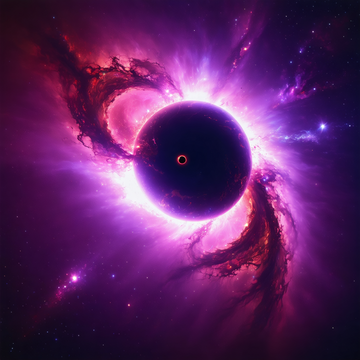
The most compelling case so far is an object called GLIMPSE-17775. Webb captured the deepest spectrum yet obtained for a little red dot, and gravitational lensing by the foreground cluster Abell S1063 effectively boosted the observation to the equivalent of about 80 hours of telescope time. The result was extraordinary: more than 40 spectral lines, many of them pointing toward the same interpretation. According to NASA and the underlying study, the source is best explained as a supermassive black hole wrapped in a hot, dense, partially ionized gas cocoon—a scenario researchers call a BH*, or “black hole star.” This does not mean a star in the ordinary sense; rather, it is a black hole whose surrounding envelope processes and reshapes the escaping light so thoroughly that the whole object can masquerade as something stellar. (science.nasa.gov)
What makes the case persuasive is not one dramatic clue, but a convergence of many. The spectral lines show signatures of electron scattering, which implies extremely dense gas; the study also reports fluorescent iron, helium, oxygen, and hydrogen features that fit a cocooned accretion model. The inferred black hole mass is on the order of a few million Suns, accreting at roughly or above the Eddington limit. This fits a broader pattern: in a 2026 NASA summary of RUBIES survey results, about 70 percent of sampled little red dots showed evidence for gas moving around 1,000 kilometers per second, consistent with accretion disks around supermassive black holes. Even so, the mystery is not fully closed. Researchers still debate whether all little red dots belong to the same family, and some alternative explanations remain in play. But as of June 2026, the “little red dots” increasingly look less like a crisis for cosmology than a fleeting, veiled phase in the birth of the universe’s earliest giant black holes. (arxiv.org)