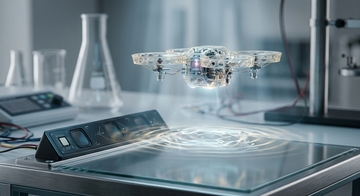
Imagine a robot that can fly without a motor, battery, or electronic parts on board. In August 2026, engineers at EPFL in Switzerland reported tiny robots that move by using sound energy. The robots contain carefully designed hollow spaces called acoustic cavities. (actus.epfl.ch)
The idea is similar to blowing across the top of an empty bottle. Air inside the bottle moves back and forth strongly when it receives sound at the right frequency. This effect is called Helmholtz resonance. In the new robots, the moving air leaves each cavity as a narrow jet. The jet produces thrust, which pushes the robot in a chosen direction.
The researchers first tested the idea with small boats. Each boat had up to three cavities, and each cavity reacted to a different sound frequency. By changing the sound from a nearby speaker, the team could make a boat go forward, turn, and move around obstacles.
They also created extremely light flying robots called “microfliers.” One model weighed only 150 micrograms and had three tiny cavities. Ultrasound—sound that is too high for people to hear—made the cavities produce upward thrust like a rocket. Another model used the same method to turn small blades at up to 13,000 times per minute. The spinning blades created lift like those of a helicopter. (actus.epfl.ch)
This method is different from simply holding an object in the air with sound waves. Here, the robot itself changes sound energy into movement. Because it does not need normal motors, gears, or magnets, it can be made very small and light.
In the future, scientists may put several sound-sensitive cavities into one flexible machine. Different sounds could then make separate parts move, bend, or shake. Such technology may lead to new medical devices and robots that can work in spaces that are too narrow for ordinary machines.